
3.4.1Do your points match? Do your slopes match?
Conditions for Differentiability
Review the definition of a derivative. Explain why a limit is needed to calculate the slope of a tangent line. Be clear in your explanation and use a diagram to help demonstrate the limit.
A line tangent to

On your graphing calculator, graph
Describe what happens to the slope of
at . Use the Power Rule to write an equation for
and use it to calculate . Explain what happened. Does this confirm what you see in the graph?
HELP!
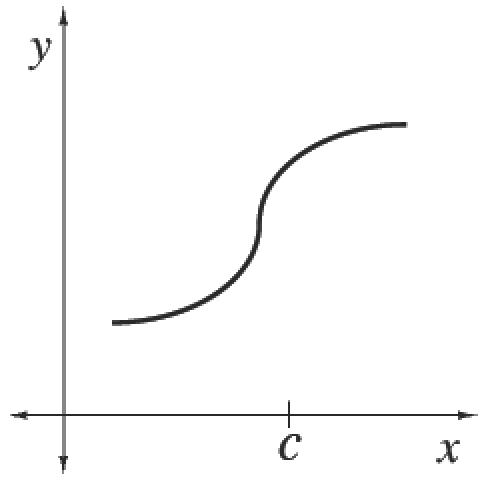
Koy’s team needs your help to settle a dispute. For the function shown in bold at right, each of her team members drew a different tangent at
Khi reasoned that if you follow
Koy does not think any of them are correct because the slope of a tangent is a limit, and a limit cannot exist if both sides do not agree.
Which team member is correct and why?
.png)
If a function
.png)
.png)
.png)
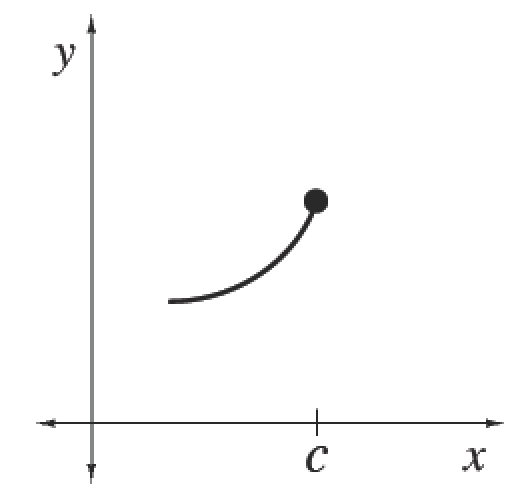
With your team, discuss why the slope of a tangent line does not exist at
in each case. Sketch
for each function. Pay close attention for what happens at . In your own words, describe when a function,
, is differentiable and when it is non-differentiable at a point, .
ANTIDERIVATIVES
If
, write a possible equation for . The equation for is called an antiderivative of . Explain why there is always more than one antiderivative.

Antiderivatives
An antiderivative of a function
The antiderivative of
Since there are an infinite number of antiderivatives that are different only by a constant term, called a “family,” we add a constant “
For example: If

Write the general antiderivative
Sketch the graph of a function that satisfies both of the following properties. Homework Help ✎
Review problem 3-109. Then on graph paper, graph the functions below and label their parts with increasing, decreasing, concave up, concave down, and point(s) of inflection. Then use the first and second derivatives to determine the intervals of increasing, decreasing, and concavity. Use different colors to represent concavity. Homework Help ✎
Use the definition of a derivative to write an equation for
State the domain and the range of each function below. Homework Help ✎
Write an equation for
Sketch a continuous curve which meets all of the following criteria: Homework Help ✎
for all
is concave down.
How many roots does
have? What can you say about the location of the root(s)?
What is
? Is it possible that
? ? For each case, explain why or why not.
Sketch a graph and write the equation of the line tangent to the curve
Re-examine your graph of
As accurately as possible, draw a tangent to
at . Estimate its slope. According to your derivative,
what is the slope of the tangent at ?


